Thursday, April 19, 2012

Sacred Sites


Pictures are below the text...

Yesterday's tour of Hiva Oa was a feast for all the senses, included the sixth if we had been tuned in at the sacred sites. Our friends on Chapter Two arranged the tour with Marie Jo for eight, so she had a full load with four people inside and four riding on bench seats in the covered rear of the SUV truck. We barely had room for all the fruit we picked en route!

Marie Jo does not speak a lot of English so I was her mouthpiece as no-one else understood as much French.I warned the group that I sometimes use my imagination if I do not fully understand, so the translation may sound more fantastical than the truth. However, the real truth was pretty unbelievable at times.

Our first visit was to a site at Ta'a'oa, dedicated to the god/chief Iupeke of the Tiu tribe. The complex of terraced rock ruins included a large grassy platform which was used for festivals (dancing and singing) and settlement of inter-tribal disputes. The big chief would sit on a paepae (stone platform) above the warriors and common crowds. The chiefess would sit behind the chief on a separate paepae. Having read Herman Melville's book "Typee", which took place on Nuku Hiva, I got the impression that women were not involved in chiefly decisions and kept in the background on these occasions.

We were not altogether surprised when Marie Jo pointed out the cooking pit where prisoners were roasted. Their heads were severed and hung in the banyan trees presiding over the complex like stately sentinels. Maybe roasted pig was on the menu most days? There was also a sacrificial stone platform for offering up the odd virgin. May the gods forgive our irreverent photo poses!

Our guide very graciously allowed us to take some papayas and tiny red chilli peppers growing amongst the ancient ruins. This was the start of our day long fruit fest! Next, we stopped at Marie Jo's home to pick up some sour apples which she cracked open on the ground. They were like under-ripe pear in taste but had thick skin, were more fibrous and contained a lot of edible seeds. I also took a few limes which had fallen off a tree and plucked some unripe mangoes for chutney.

The forty three kilometre drive to the sacred site of Puama'ou was along a windy road which wove through lush valleys of fruits and flowers and up and down the coastal mountains. A lot of it was unpaved and, like the logging roads up north, very rough. Marie used her first gear quite frequently as we either nose-dived down or strained up the steep, rutted and rock strewn route. while on one side we had tremendous views of the ocean and the islands of Mohotani and Fatu Uku, on the other we marveled at the nimble goats hopping up and down the rocky slopes.

Occasionally we passed through a small village at the head of a bay and waved at the few locals walking by. According to Marie these people make their living by fishing or gathering fruits like coconuts and noni for export.

We stopped frequently to pick up guavas hanging from roadside trees and to take photos of the wonderful panorama. I love fruit but even I was guava'd out by the time we reached Puama'u!

The large ceremonial site, Me'ae Iipona, at Puama'u is located on the northeast of the island. We were very impressed at the number of well perserved tikis still standing after thousands of years in an unprotected wet forest area. The largest tiki outside of Easter Island is of the great warrior Chief Takii. There is also a female tiki representing the priestess Tau'a Pepe who died giving birth to a son. Carved by her husband, the statue shows her in throes of death (maki'i). Carved heads placed at various places represented human sacrifices.

In the softly falling drizzle we felt awed by the beauty of the carvings. The hushed atmosphere of the temple was hardly disturbed by Marie Jo wacking pamplemousse from the trees with a huge bamboo stick!

While the rest of the group had a pre-ordered typical Marquesan lunch in the village, Chris and I opted for a beachside vegetarian picnic of baguettes and Camembert cheese. It was quite delicious. We also realised why Puama'u is not a good place for access by sailboat. The rollers are quite ferocious and unless you were a champion surfer you would be in deep peril trying to land on shore.

We barely stopped on the journey home.Of course We had to stop for a short hike in the forest to say hello to the  "Smiling Tiki".

It's a good thing we went on a guided tour yeesterday. Our own attempt at finding a local petroglyph site today ended prematurely where a swollen river blocked the trail, as dark and ravening hordes of mosquitos descended.


Beach at Puama'u

Unusual prone Tiki (possibly used for sacrifices?)

Tiki of Chief Takii at Me'ae Iipona

Maki'i tau 'a pepe

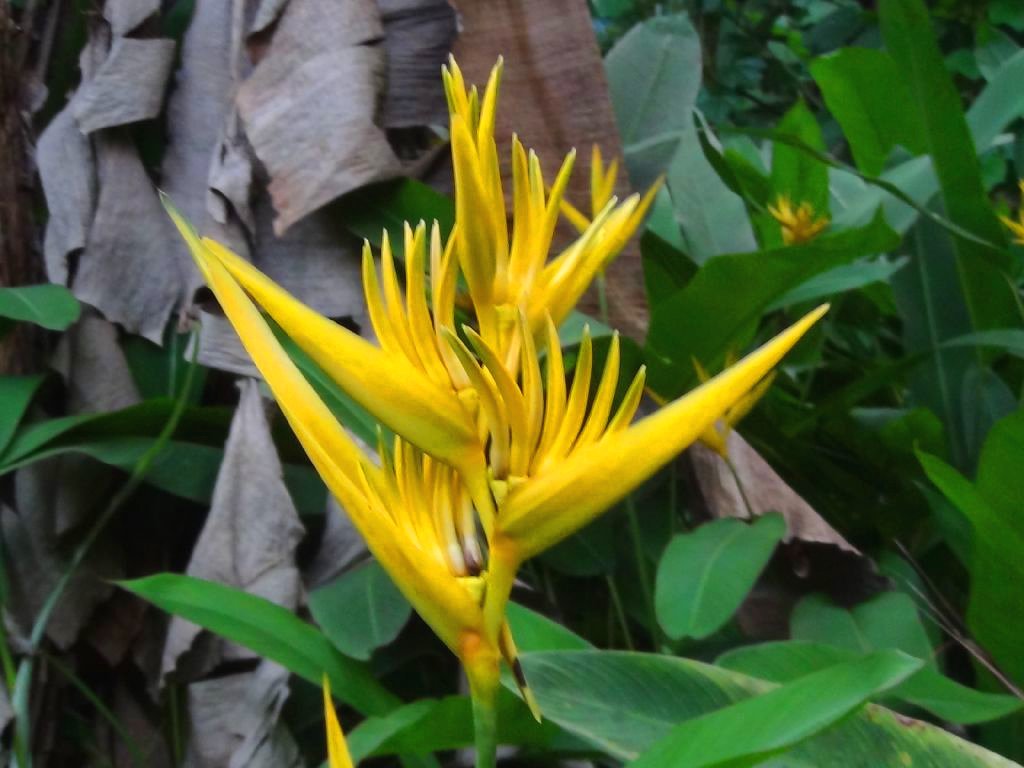
Bird of Paradise Flower

Rani imprisoned

Tiki of Iupeke

Ceremonial grounds at Ta'a'oa

Goats were common along the road

View towards Atuona - note tree ferns

Our tour group


Hibiscus flowers are worn by Polynesian women
Me'ae Iipona site at Puama'u

Prone tiki at Me'ae Iipona


Brian off  S/V Zulu looks at Tiki of Chief Takii at Me'ae Iipona 

Me'ae Iipona site at Puama'u

Marie Jo - our tour guide and Marlene off S/V Zulu

Beach at Puama'u
Ata kua - smiling tiki


Atuona


In our first couple of days, we visited Gauguin's grave, where we had a lovely picnic lunch with Mike and Karen off 'Chapter Two'. We also met Marie, a local lady, who gave us a tour of her little plantation, taught us about the local edible fruits, and showed us how to de-husk and open ripe coconuts. She loaded us down with fruit including a couple of stems of bananas that are now all ripening at once in our cabin - we hope to dry some if the sun cooperates.

We have really enjoyed the bounteous fruit - hanging from trees along every roadside. Pamplemousse, guavas, bananas, and a slightly tart fruit called a pistache that also has a seed, which can be roasted and eaten but is no relation to the pistachio we know. Rani remembers the latter fruit as a 'jamun' from her childhood in India.

Today is a chores day after our day long island tour yesterday (see next blog post) and we have taken on water and processed hundreds of photos. Rani is currently off in town visiting Marie and trying to access the Internet at the post office.

Ladybug at anchor in Taahuku Bay

View over Atuona

Climbing the hill to Gauguin's grave

Sculpture beside Gauguin's grave

Picnic with Mike & Karen

Rani and pamplemousse


Marie and her daughter Maria

The beach at Atuona

Clarion Island


A few pictures from Clarion Island, which we visited on day 6. Lovely rock formations but an untenable anchorage and no chance of landing in one piece, so we stayed only two hours.

Northwest tip of island


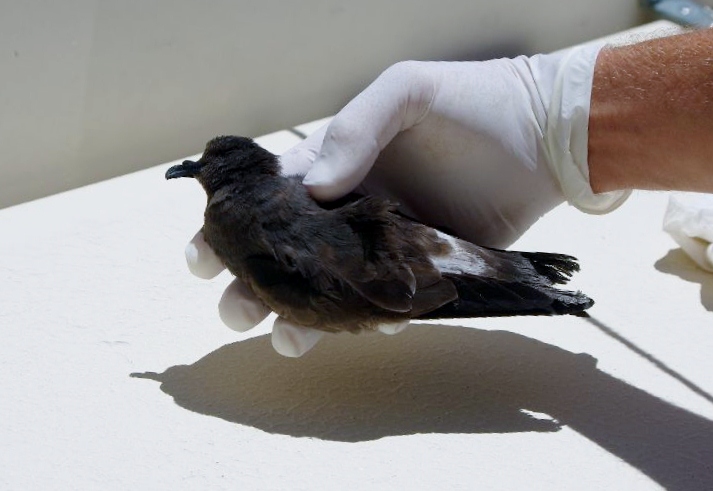
Petrel


Bahia Azufre (Sulphur Bay)

Surf on the beach - note wrecked barge behind surf break and military base to left. The swell in the anchorage was impressive!

Poor exhausted petrel passed away in our cockpit.


Pictures from the Crossing to the Marquesas


Twenty six pictures for the 26 (well 25 and a bit) days. The detailed text for these pictures can be found in previous radio posted blog entries. The photos show a mix of wildlife, weather, repair work, and celebration.

Dolphins in the bow wave

Approaching squall


Tanker passing at dusk

Blue water swim

Fixing a bulkhead bonding problem with thickened epoxy

Red footed booby on the solar panel

Flying fish rigor mortis

Baby flying fish - these fish landed on board ranging in size from an inch to 9 or 10 inches

Fixing a leak in the rudder steering tube

Fixing another leak in the traveller bolts through the coach roof.

Rani boning up on her French.

Strumming near the equator 

Getting the bubbly ready for equator celebration

Equator GPS - a bit late as we were toasting and bribing Poseidon

One for Poseidon, one for us

Sweetened rice offering to the Gods

Cleaning up after the squall (we left a hatch open!)

Squall in real life

Same squall on radar

Amazing squall area clouds

More squall clouds

Approaching Hiva Oa - We use a free chart software (OpenCPN) as back up to paper charts

Happy to see land!

Approaching Hiva Oa

The hook is down in  Taahuku  Bay, Hiva Oa

The anchorage at Taahuku


Sunday, April 15, 2012

First day in Hiva Oa

Today we walked into the little town of Atuona and bought fresh French baguettes, Brie, and Camenbert from two of the three small groceries that line the main street. Rani stopped to chat with a young Marquesan who climbed a nearby tree and picked for her a ripe pamplemousse (a sweet variety of grapefruit). Later, we climbed the hill above the town to the cemetery where the painter Gaugin is buried. Rani observed that, as in many European cities, ironically the dead enjoy the best views.

Atuona is a beautiful place - a sort of French tropical suburb as our friends Mike and Karen on 'Chapter 2', who accompanied us, put it. We ate our picnic lunch with a view from the graveyard out over an impossibly lush 1000 meter mountain, with the surf pounding on the black volcanic beach at its base. The baguettes tasted just like the ones you buy in Paris, the Brie was smooth and delicious, and the Normandy Camenbert intensely flavourful.

It was a sweltering walk back, but a friendly and very tattooed islander generously picked the four of us up and dropped us back near the boat - nice people here! The chilled beer we enjoyed in the shady cockpit of 'Chapter 2' tasted ridiculously good and Mike insisted it would restore the electrolyte balance.

Tomorrow we check in with our agent and the next day we have arranged to take a tour of the island by car to see the archeological sites and other villages.

Saturday, April 14, 2012

Land Ho - Day 25/26

Day 25 was the fastest yet. We covered 144 nautical miles, broad reaching in 15 to 20 knot easterlies during the day and lighter easterlies at night. There were squall lines still, but more spread out and with less punch than those of the previous day. Two reefs in the main, then one as the winds died. We kept the jib partially furled to reduce backing and slatting in the rolly swells. Despite this much reduced sail, we still regularly reached 8 knots on the GPS with some 9 and 10 knot surfing - great fun.

At 14:30 Zulu on Saturday April 14, our position was 09 36 S 138 29 W. We ran 144 NMs with 137 made good in the previous 24 hours.

Just before sunrise, this morning, 25 days after leaving Los Frailes, we sighted Hiva Oa lying under a bank of cloud in the pre-dawn haze. We danced on the deck hugging each other and cheering - what a sight after nearly 4 weeks at sea! We dropped the hook at 14:50 Marquesas time (UMT - 9.5 hours) and our friends Mike and Karen on 'Chapter 2' dinghied over to help us set a stern anchor (the anchorage is small and very crowded so the two anchors are needed to avoid swinging into your neighbor).

We are now anchored at 09 48 S 139 02 W in Taahuku a.k.a. 'Traitor's Bay' near the village of Atuona. There is an outrigger canoe race in progress and music is playing from the boat ramp. There is a horse grazing in the woods by a surf pounded beach off our stern and a huge cloud-shrouded green sided mountain rising to starboard. The sights and smells of this paradise are overwhelming. We will sleep well tonight.

The total distance we sailed/motored from Los Frailes, Mexico was 2932 nautical miles by our GPS 'odometer' at an average speed of 4.8 knots. We motored for 36 hours in total, using approximately 15 gallons of diesel. About 8 hours of this motoring was done mainly to recharge batteries due to problems with refrigeration. This did not contribute substantially to boat progress because we were sailing at the time. We stopped for only a couple of hours at Clarion Island and for another hour or two to scrub the boat's bottom.

This will be our last passage report for now but we will try to update the blog regularly while sailing amongst the Marquesas. Our tentative plans are to visit 5 of the islands, spending 4 or 5 days at each, before departing for the Tuomotus.

Friday, April 13, 2012

3000 Mile Diet - Day 24

Who would have thought we would still be eating Greek salad, with fresh green pepper, cucumber, tomato, red onion, black olives and Chiapas cheese, 30 days after provisioning in La Paz?

Living without a fridge for the last three years in the hot climate of Mexico has taught us a few things. We have learned to choose fresh vegetables and fruits with a discerning eye, preferring to buy non-refrigerated produce from the farmers' market. The Mexican vendors do not mind if we handle the produce to avoid bruised or over-ripe fruits/veggies. We have also discovered "new" vegetables, which naturally keep longer, like chayote (a good zucchini substitute) and jicama.

Once onboard, we carefully wrap each delicate item in brown paper, cut-up bags we had saved from bakery and wine purchases. Newspaper also works but glossy magazine paper is not good because it does not breathe. Our produce locker has stacking plastic baskets with holes in the sides for airflow and we almost always leave the lid off this locker to allow air in. These two steps seem to help prevent the goods from chafing and going moldy, keeping things dark but ventilated and not too dry.

This voyage to Polynesia is on a different scale from our usual 2 or 3 week Mexican stints. We bought enough produce to last 4-5 weeks, in case we got stuck in the doldrums, and were prepared to sacrifice some along the way. The oranges and apples were hung in hammocks, the vegetables split between the galley produce locker and an open Rubbermaid container under the quarter berth. I unwrapped and aired vegetables, other than potatoes and onions, every day or second day, depending on the sea state. We placed the most ripe tomatoes, green peppers, cauliflower and avocados in the fridge, once space became available, 7-10 days after leaving La Paz. The same applies to cut vegetables which have been partially used, like cucumber for example.

Our loss has been minimal - in more than 4 weeks of sailing - two grapefruits, one orange, one tomato and several carrots. We ate the last zucchini two days ago and still have kilos of onions and potatoes, several cukes, some carrots, cabbages, jicama, chayote, poblano peppers, and even a few tomatoes and an avocado. Admittedly, the carrots and peppers look rather gnarly. In the fruit department, we have ten oranges, lots of limes and a few dozen 5000 mile apples from Washington (via Mexico). No scurvy victims on Ladybug!

Now - we just have to get through Friday the 13th and hope that when we make landfall, the inspectors in French Polynesia allow us to keep our hard earned veggies and fruit!

More on favourite at sea recipes at a later date as I am feeling a bit nauseous in the bouncy seas today.

Our position at 1430 Zulu on Friday April 13 was 8 12 S 136 35 W. We sailed 136 NMs in the last 24 hours and are 155 NMs out of Hiva Oa. Note that the captain had us going to the wrong waypoint (40 miles east of where we should have been aiming), so our previous entries for miles to run are wrong and we will probably reach Atuona by tomorrow afternoon. He should leave the navigation to the first mate :)

Thursday, April 12, 2012

Light and Dark - Day 23

Three full pages in the log on day 23 - mainly devoted to describing sail and course changes to deal with squalls. Two of these had enough rain for showering and catching and I blocked a scupper and topped off the starboard tank during the second one. Last night, the stars were repeatedly blocked by towering walls of blackness and we slept little. I woke a couple of times to Rani's frantic plea for help and a frightened 'doe in the headlights' look on her poor little face. We sailed the whole night through under 2 reefed main and 1/2 furled jib - maybe 225 square feet of sail, easily pushing our 10 tons of boat at 6 knots through the pitching blackness.

Our friend, Kurt, requested some comments on the changing 'starscape'. The stars are indeed different below the line, with the southern cross being the most notable. The milky way is stunning when the moon is not yet risen, but I am sorry to admit that I have been too sleep deprived and busy with keeping the boat going to delve into constellation identification. In fact we welcome the bright, star-obscuring moon of the last few days as it better shows up the squalls. More on stars, perhaps, when we reach port.

On the light side, we can see the end of the tunnel. Our progress through 'squall alley' has been very fast with a 135 NM run in the last 24 hours. We are less than 270 NMs from our destination and may even reach Hiva Oa in the daylight on Saturday. A green and tranquil vista will be most welcome! Our position at 1430 Zulu on Thursday April 12 was 06 22 S 135 19 W.

Wednesday, April 11, 2012

Squall Line Dancing - Day 22

They began steam rolling in east to west at 4am on Day 22 and are still with us. The towering cumulus clouds with dark bases that brought wind in the 20-25 knot range were easily seen during the day. In between were smaller cumulus clouds but all together they formed a line that looked like a freight train. Most of the time one train would pass in front of us and one behind us as if someone were actively guiding Ladybug in between two sets of tracks.

We kept the radar on to trace their path. The rain bearing fronts were visible at around 12 miles and it was fascinating watching their shapes changing as they neared. Chris judged the wind by the advancing white caps and waited till the very last moment to put in a second reef in the main or furl the jib. Within minutes of the squall passing, he would be up on deck shaking the reef. Wind continued at 15 knots as each set passed by and we used it to gain as much distance as we could.

At night, before the moon rose, it was harder to see the non-rain bearing squalls as they were not up on radar, so we kept a second reef in the main at all times, using the jib for finer control when they arrived. Early this morning there was a sinister looking black mushroom cloud that was 2 by 3 miles in size. It looked like a towering inferno as the sun rose behind it and back-lit the sky a golden orange. Its younger sibling trailing close on its heels caught us broadside and we both took turns to shower under the cool rain. When I looked at the radar afterwards the two were joined like Siamese twins.

"Weather forecasters define a squall as a sudden increase in wind speeds by at least 16 knots, resulting in the speed rising to at least 22 knots and lasting for at least one minute. In some areas squalls are most frequently associated with land masses, whereas in others they may occur frequently in open waters. The majority of tropical squalls are moderate (wind speeds less than 35 knots) and rarely pose a problem for sailors." - Tropical Cruising Handbook by Smaalders and Rochers. I take heart in this and am happy to report it has been so in our short experience.

The after effects of the squalls are sometimes worse. The seas build up and as the wind drops down, we have short choppy seas which toss and turn Ladybug up to 20 degrees in either direction. Cooking is no longer fun!

At 1430 Zulu on April 11, our position was 04 40 S 133 56 W and distance run within last 24 hours was 129 nautical miles. We were 400 miles from Hiva Oa, with 121 miles made good.

Tuesday, April 10, 2012

Drying out and Squall Prep - Day 21

We are currently sailing in a world of towering cumulus clouds, squalls, and rainbows.

Most of yesterday was spent going through the long term 'dry' locker (a misnomer on a boat, surely), which was the recipient of a gallon or two of sea water in the previous evening's squall. Rani removed all the items, soaked up and bailed out standing water, and wiped everything down. I made water with our water maker and washed the sheets, towels, sail bags, etc. The boat was pandemonium all day with 6 months of food and all the 'stuff' that accumulates in a V-berth spread out to air. Of note is that, due to Rani's excellent packing, we ended up with sea water infiltrating only 2 bags of sugar. The result is kind of like salt water taffy and I look forward to an extra ration of sweets...

We were much better prepared last night and had 2 reefs in the main all night with the hatches battened down and a vigilant radar watch. Of course we had no direct hits from squalls of any size and made miserable progress in very light airs. Early this morning the wind disappeared completely and a rolly swell began to toss Ladybug on her ear. We turned on the engine and motored for the longest period to date - about 6.5 hours! We saw a SE wind return this morning and are encouraged by reports from boats to the south that this has been consistent now for 24 hours.

Our position at 14:30 Zulu on April 10 was 02 56 S 132 43 W. We sailed/motored 91 miles in the previous 24 and are 521 miles out of Hiva Oa.

Monday, April 9, 2012

Docile day turns into a stormy night - Day 20

It was another light air day with an easterly wind of 1-4 Knots most of the morning changing to 4-8 knots from the ESE by the evening.

At 8.45 am we took down the sails and Chris jumped into the warm ocean to swim and clean the bottom. There were gelatinous masses of gooseneck barnacles clinging to the propeller shaft, strut, all along the aft section of the bottom, and along the keel. It took him almost an hour to scrape the worst areas. I stood on "jelly watch". Last year a friend of ours had an encounter with a Portuguese Man O'War mid-Pacific and he suffered for days from the poisonous sting. Well, I did not see any jellyfish but screamed the alarm when a three foot long transparent animal appeared. It must have been about 3-4 inches in diameter, had a faint pink colour around the edges and was slinky-like in shape. I had no idea what it was but warned Chris to swim away as it seemed to be drifting in his direction. If anyone can identify what it could be, please let me know.

We flew our spinnaker from 10 am to 9 pm with a couple of hours of downtime mid-afternoon when the lack of wind and large swell forced us to turn on the engine. Taking advantage of the extra power, we made water and I started to wash laundry using a couple of plastic buckets in the cockpit. Soon we had our t-shirts and pillow slips flying from the life-lines and rat-lines while the smalls had their own line crisscrossing the cockpit. It all looked colourful.

After the sun had set I gathered up the larger clothes and we watched a bit of "television". At first watch (9pm), I asked Chris if we could take down the spinnaker as it can be a liability at night when only person is on deck. Since the wind was now 8 knots, he agreed and we put up the main and jib. I went to sleep on my fresh smelling pillows with a peaceful mind while he stood first watch.

At 11.30 pm, I was woken with a light kiss on the cheek and a request to assist with reefing the main. As soon as I poked my head out of the cabin, I could hear the wind howling. Chris shouted " There is no time to reef, I have to steer us downwind, dog-down the hatches!" I ran below to close the port lights in the cabin and was dismayed to see saltwater spraying over the bunk where I had been sleeping. Worse was the sight of gallons of water pouring over the v-berth from the hatch above it. I secured everything and rushed back up to the cockpit. It was a sickening feeling, watching Chris struggling to keep the boat under control with all his might. The wind was probably 35 Knots from the northeast, gale force, and Ladybug was screaming downwind at 8 Knots. Chris ordered me to furl the jib and that was hard even using the winch as there was so much force on the sails. The rain started to pour, so I passed out a coat to Chris and closed the main companionway hatch.

The radar showed a 4 mile radius of squalls but we could not dodge them even if we had tried as the NE wind forced us to steer SE to SW to keep the boat under control.

It was a nightmare that lasted for about an hour. There was one accidental gybe which caused damage to the traveller. A bolt attached to a tang at the end of the starboard traveller line sheared off and the tang was completely straightened out by the wind. Chris found it lying on the deck after the squall had abated. We shall see if it can be fixed in the daylight. Thankfully the traveller is still functional.

When the wind abated a little we double reefed the main and hove to, later we turned and ran southwest with the same configuration. The rest of the night was spent sponging off the salt from the contents of the v-berth, watching the radar very closely and, in my case, praying for a quieter morning.

At 1430 Zulu today our position was 01 33 S 132 11 W on a course of 205 degrees magnetic. Our 24 hour run was 93 nautical miles and we were 612 NM from Hiva Oa.

And we are now into sunshine with some blue sky ahead...

Sunday, April 8, 2012

Champagne, rice, and prayers - Day 19

At 10 minutes to 9 last night we sailed into the southern hemisphere at a sedate 3 knots. All day we had discussed how to celebrate, settling on a nice mixed veg and soy/pea curry dinner, followed by Spanish 'champagne' and dark chocolate. We tried to capture this on film, realizing too late that you cannot snap a picture of the GPS at the equator and pour a libation over the side to Poseidon at the same time. So we went with Poseidon's drink and captured the GPS reading a bit south.

Rani made a traditional Hindu offering of rice - wrapped in a paper boat, which followed the champagne. I read Rani a short poem that I had written for her. Rani played a recording of the Sikh evening prayers and bowed her head in prayer. In all the rolling we spilled yet more bubbly, so hopefully Poseidon has been appeased. His friends - the various winds - must require something other than champagne because we have had little to no wind all day and night! This may change today, for I see a mass of black cloud approaching from the north as I type.

Our position at 14:30 zulu on April 8 was S 00 29 and W 131 19. We ran 73 nautical miles yesterday and have 695 more to go to Hiva Oa.

Comment on the Slocum post

My friend Kurt wrote an interesting comment on yesterday's post...

"Your comment on the Slocum factor was interesting, but I think you left out a very critical part. Old Josh sailed off in to a world which he knew to be finite and went from A to B because he was a ship's captain by trade. But for 99.999999% of the world's citizens then, a journey of 50 miles was huge. And any journey left you vulnerable to little or no contact with loved ones at your root. Another continent was unfathomable. I am sure that any desperate immigrants to the US and Canada had next to no idea where they were going. We live in a world that is not necessarily smaller, the usual comment, but rather our minds and awareness have expanded to encompass it, to say nothing of our technology. We "think" the whole blue marble into existence now, and see it as one thing. In Slocum's day any journey, even by rail or steamship, required steely nerve of overwhelming need. Today we can afford to think of a sail to the Marquesas as a grand adventure, a choice, even a bit of retro wind powered fun that sets us apart from everyone else, both literally in the moment and in another way permanently. In part we do this stuff in search of that feeling that says we are "different" and have "been there". And it makes us part of a smaller "family" than simply of "those who pay their taxes on time". But you still need to be excruciatingly careful!"

Thanks for this perspective Kurt - technology is probably not the most important factor in what we attempt or achieve...

Saturday, April 7, 2012

Advantages over Slocum - Day 18

The ARC rally has just left the Marquesas en route to Tahiti. These sailors are part of an organized, 'guided' cirmcumnavigation that they will complete in less than a year and a half. This got me thinking about all the people like us who are out here cruising on small boats. Sailing boats across oceans used to be reserved for professionals and the occasional publicity or thrill seeking adventurer. This is clearly not the case any more. What has changed to allow an average couple to sail a small boat across the Pacific or around the world?

When Joshua Slocum became the first person to sail alone around the world at the end of the 19th century, he did so using tools and techniques that were hundreds, if not thousands of years old. He navigated via sextant and clock, used kerosene to light the interior and for running lights, and sailed in a boat that was built by hand of wood and iron. The radio had yet to be invented, let alone, navigation assisting satellites. He carried water and salted food in barrels and jugs. His sails were made of cotton canvas (or possibly flax) and needed constant care.

Here is a short list of technological changes that have made what we are doing feasible:

* Beginning in the 1950's Fibreglass and polyester resin enabled the mass production of sturdy cruising boats. Polyester and nylon also replaced cotton in sails and natural cordage in lines.
* Reliable small diesels made getting in and out of harbour or crossing the doldrums far less challenging.
* Wind vane self-steering, first widely used in the 1960's made short handed cruising infinitely more pleasant, reducing the need to stand at the helm staring at a compass for hours. Electric autopilots provided similar benefits.
* Radio and satellite communications made it feasible to obtain up to date weather information and stay in touch with other sailors and those who remain at home.
* Radar allowed us to 'see' over the horizon to avoid being run down, to move with more confidence in fog and poor visibility, and to enter strange harbours.
* Satellite navigation (GPS) removed the need to learn celestial navigation (although some still argue against over-reliance on this technology).
* Solar panels - another product of the space age provided silent 'free' power. Small wind and gas or diesel generators also provided power for the comforts of life that many of us take for granted.
* Refrigeration, propane stoves, and water makers brought the comforts of home on board.

These technologies are enablers - taking much of the risk and discomfort out of long distance cruising. I am sure it is no coincidence that dozens of people now complete circumnavigations each year compared to the handful who had done so before 1950.

Our position today at 14:30 zulu was N 00 41 W 131 16. We sailed only 93 miles (with 1 of those under motor this morning). Winds have varied from 1 knot to about 12 mostly out of the east and we had a decent spinnaker run in the afternoon. We also fixed a problem with the fridge thermostat by relocating it from the cockpit locker to the inside of the fridge. We hope to cross the equator sometime today, being only about 40 miles from it now! The champagne is chilling.

Friday, April 6, 2012

Peaceful Day on the Pacific - Day 17

We passed through a rather nasty looking ITCZ front of thick clouds, wind, rain and then total calm on Wednesday night and in the early hours of Thursday morning.

During the calm period, Chris turned on the iron jenny and we motored for about an hour. We called in our crew, Frankenpilot, to steer us but he packed it in immediately, feigning sick. Upon examination, it was found that old Frankie had swallowed some water during the squalls and it had gone the wrong way - into his electronic board. We undressed him and laid him out to dry out overnight while our newest recruit from West Marine, Stevie 2000, subbed in.

There was light at the end of the tunnel around 5am as a steady 3-4 Knot SE wind came up and we put up a full jib and main to push us along at 3 Knots. This light breeze continued throughout the day. The boat rolled a bit due to swells from the north and northwest but we put up the cockpit awning and relaxed "upstairs" under it's shade. The fresh breeze tickled the skin and Ladybug settled into an easy pace for the day.

I wished for dolphins and sent out telepathic messages. They appeared in droves. Well, at first there was a recce party of about eight. Then there were splashes and sleek bodies leaping out of the water everywhere for about a mile out. And they were headed our way!

Between 50 to 100 striped dolphins swam, dived and jumped all around Ladybug for about forty minutes. We encouraged them by filming and cheering them on. What an afternoon!

As predicted, we did not set any records this day, gaining only 101 miles over 24 hours. Our position at 1430 Zulu on April 6 was N 01 56 and W 130 27. After a strategy consult with our friend Mark on s/v Southern Cross, we changed our course from due south for the equator to 210 degrees true for Hiva Oa, 935 nautical miles out, so we cannot report the distance made good.

Thursday, April 5, 2012

Our Little Universe

These days we live in our own little universe. It is an ever changing universe of mainly two colours - blue and white and all shades thereof. The ocean varies from the Royal Blue of a sunny day like today to the dusky indigo of the early evening. In the moonlit night it becomes molten silver and graphite grey. Night or day, it is always laced with white. It heaves and pulses like the living beast it is, the energy in it's belly speaking of unpredictable power.

The sky above is of different hues of blue. The baby blue at the sea surface deepens a few shades as one gazes higher. Fluffy cotton clouds hang picturesquely in this ceiling like the trail of a steam engine. On the horizon all around us they coalesce and are interlaced with grey. When the sun sets these same benign clouds will appear darker and evil. It is little wonder that mankind through the ages has worshipped the sun, the bringer of light and goodness.

Ladybug is bouncing alone in this universe like a puppy on a short leash. We know there are other other sailboats within a hundred mile radius but we have not seen any for 16 days. We live in a Water World.

Sunburn, spinnakers, and reverse osmosis - Day 16

The sun at 4 degrees latitude is dangerously strong. It has been so hot and humid that we are down to our underwear. I have rather badly burned the top of my legs after very brief (pun intended) exposure. We rigged the small cockpit awning that allows us to sail with it up to get some relief from the rays, but later had to strike it due to squalls.

The day began with very light NE winds, which pushed us along at 4 knots broad reaching. Our starboard water tank ran dry, so we realized it was time to bring the water maker back into service (it had been 'pickled' with sodium metabisulphite back around Christmas). The water maker does not like rough seas or fast sailing, getting air bubbles in the system. This causes the 800 psi pressure required for the reverse osmosis to work to drop to about 200 psi, so we sailed the whole morning at an increasingly sedate pace, making about 20 gallons of water in 3 hours.

Around noon we took another sextant sight. This time, the sun passed behind us as we headed south while I was taking the sites - a very strange feeling to have it go to the north of us. Our location was only within 7 miles of the GPS one on this sight - again our longitude was good (within a mile or to), but our latitude off. Not sure what I am doing wrong, but hope that further practice will get us a bit closer.

By early afternoon, the wind was down even further and we had perfect conditions for a spinnaker run. We hoisted the cruising chute for the first time on this crossing and our speed immediately returned to 4+ knots. We spent the afternoon rolling down toward the equator with the big red and white balloon gracefully towing us along. Unfortunately all good things must end and around supper time, we ran under another line of towering cumulus clouds filled with rain and wind. I held onto the chute until the last minute, raising Rani's blood pressure, but just before the first squall we doused it with its snuffing sock and re-hoisted main and jib.

All last night we had very light winds from the east and south east with a few squalls. The first major squall was enough for another cockpit shower - a welcome relief after sweating for 2 days in 90 degree heat!

Our position at 14:30 zulu on April 5 was N 03 19 W 129 33. We ran 99 NMs making good 93 toward our equator crossing point (199 miles to go!).

Wednesday, April 4, 2012

Squalls and Sunshine - Day 15

Monday night and the early hours of Tuesday morning were busy hours on deck as we passed through confusing systems of light airs with lightning and heavy showers accompanied by 20-25 Knot winds. Watches were unfair as I had to ask Chris to tend to the sail changes on my shift too. Due to the large frequent swells rocking the boat it was a tough balancing act lifting the heavy teak hatch door aside as we entered and exited the cockpit in the rain. I was happy that we had taken the pole down earlier in the evening - that would not have been a lot of fun in those conditions.

On the plus side, both of us took a refreshing rain shower to wash off the sweat and grime.

We continued on a westerly course. In the early afternoon we could see blue sky ahead and figured it was time to make the left turn to head south. We put in a new way point to the equator. Only another 384 miles to the line! The sunshine was a boost to spirits, the wind on the beam - God was smiling upon us again!

Our position on April 4 at 1430 Zulu was N 04 50 and W 129 11. We managed to sail 129 nautical miles despite the ITCZ conditions.

Tuesday, April 3, 2012

Squalls to the left of us, squals to the right of us - Day 14

Ladybug is definitely in the doldrums. We have spent the last 24 hours dodging squalls and listening to the rain pound the decks in a torrential deluge. The squalls sometimes pack a punch, with winds increasing to 25 knots or more, resulting in frantic sail changes- three of these last night in the wee hours. I did one sail change sans clothes and had a very effective shower at the same time. We found a leak in the cabin 'roof' where the traveller for the main sheet is attached and had to take apart the interior to find and fix this. In one of the squalls I sacrificed the rubber end of our flashlight to Neptune when the jib sheet was jerked out of my hands.

The radar has been a great help in squall watching - they show up as evil looking chunks on the screen in contrast to the elegant little blips that a ship would make. We are fairly near a shipping lane that runs from Panama to the Philippines, so the person on watch has to be doubly vigilant.

As of 14:30 zulu on April 3, we were at position N 06 23 and W 128 28. We ran 126 miles but only 99 of those in the right direction. Hot and muggy below with all hatches battened down.

Monday, April 2, 2012

The Doldrums

Being at approximately 7 degrees north and 127 degrees west, we are now officially in the doldrums or the Inter-Tropical Convergence Zone as NOAA calls this area of rain squalls, variable winds, and lightning:

From the April 2 NOAA forecast:

INTERTROPICAL CONVERGENCE ZONE/MONSOON TROUGH...
ITCZ AXIS EXTENDS FROM 09N121W TO 04N140W. SCATTERED MODERATE
WITHIN 75 NM EITHER SIDE OF AXIS BETWEEN 129W AND 133W.

The GRIB (weather model) file shows a 1012 millibar gradient running north east to south west just below us, with a 1012 high to the southeast and a 1012 low to the northeast of that. Not sure how one can have a high and a low beside each other with the same pressure, but - hey - I'm no meteorologist.

Practically - this means that our 140 mile days are over for a while. The ITCZ should go somewhere else in a couple of days if the GRIB forecast files are correct, but it looks like we are in for a couple of days of frustrating sailing, dodging rain squalls and lightning.

Halfway - Day 13

Well - we are more than halfway to Hiva Oa, passing the halfway point (as the seagull flies) at mile 1308 around 2 pm local time yesterday.

We have begun to pass through rain showers and impressive cloud formations. During the first good morning shower, we stripped off and jumped into the cockpit, lathering up and then dancing around in the cool clean heavy rain - lovely!

We also finally had suitable conditions to do a noon sextant site, following instructions drafted for us by Kurt ('Kaptain Krunch') off S/V Raven.

Here is how we did this:

1. Adjusted our clock to a time signal broadcast over the SSB radio so that it was correct for Greenwich time.
2. Looked up when the real local noon (sun as far overhead as possible) was according to our rough current position.
3. Took a series of sextant 'shots' that bracketed this time, to determine a) the maximum height above the horizon of the sun and B) When exactly that height was reached (local apparent noon). This is quite a fun exercise as you swing the sextant back and forth, watching a little red ball (the filtered sun) arc back and forth like a pendulum. The trick is to know when the bottom of the red ball just grazes the horizon. This is not always easy on a rolling boat with 6 foot swells getting in the way.
4. Adjusted these numbers for factors such as how high we were above sea level (about 2 meters), errors in the plastic sextant, and the half diameter of the sun.
5. Looked up various values in the 2012 nautical almanac that use these data to obtain lat and long.

According to our GPS, we were only off by 4 miles in our sights - very good for our first attempt using Kurt's instructions. We tried this once before using the simple instructions from the sextant manual and only achieved a 30 mile accuracy!

Our position as of 14:30 zulu this morning was N 07 04 and W 126 38 for a day's run of 126 NMs with 123 of them in th right direction. Winds became light and shifting with lightning and showers in the early hours this morning, which has slowed us down.