Thursday, April 19, 2012

Sacred Sites


Pictures are below the text...

Yesterday's tour of Hiva Oa was a feast for all the senses, included the sixth if we had been tuned in at the sacred sites. Our friends on Chapter Two arranged the tour with Marie Jo for eight, so she had a full load with four people inside and four riding on bench seats in the covered rear of the SUV truck. We barely had room for all the fruit we picked en route!

Marie Jo does not speak a lot of English so I was her mouthpiece as no-one else understood as much French.I warned the group that I sometimes use my imagination if I do not fully understand, so the translation may sound more fantastical than the truth. However, the real truth was pretty unbelievable at times.

Our first visit was to a site at Ta'a'oa, dedicated to the god/chief Iupeke of the Tiu tribe. The complex of terraced rock ruins included a large grassy platform which was used for festivals (dancing and singing) and settlement of inter-tribal disputes. The big chief would sit on a paepae (stone platform) above the warriors and common crowds. The chiefess would sit behind the chief on a separate paepae. Having read Herman Melville's book "Typee", which took place on Nuku Hiva, I got the impression that women were not involved in chiefly decisions and kept in the background on these occasions.

We were not altogether surprised when Marie Jo pointed out the cooking pit where prisoners were roasted. Their heads were severed and hung in the banyan trees presiding over the complex like stately sentinels. Maybe roasted pig was on the menu most days? There was also a sacrificial stone platform for offering up the odd virgin. May the gods forgive our irreverent photo poses!

Our guide very graciously allowed us to take some papayas and tiny red chilli peppers growing amongst the ancient ruins. This was the start of our day long fruit fest! Next, we stopped at Marie Jo's home to pick up some sour apples which she cracked open on the ground. They were like under-ripe pear in taste but had thick skin, were more fibrous and contained a lot of edible seeds. I also took a few limes which had fallen off a tree and plucked some unripe mangoes for chutney.

The forty three kilometre drive to the sacred site of Puama'ou was along a windy road which wove through lush valleys of fruits and flowers and up and down the coastal mountains. A lot of it was unpaved and, like the logging roads up north, very rough. Marie used her first gear quite frequently as we either nose-dived down or strained up the steep, rutted and rock strewn route. while on one side we had tremendous views of the ocean and the islands of Mohotani and Fatu Uku, on the other we marveled at the nimble goats hopping up and down the rocky slopes.

Occasionally we passed through a small village at the head of a bay and waved at the few locals walking by. According to Marie these people make their living by fishing or gathering fruits like coconuts and noni for export.

We stopped frequently to pick up guavas hanging from roadside trees and to take photos of the wonderful panorama. I love fruit but even I was guava'd out by the time we reached Puama'u!

The large ceremonial site, Me'ae Iipona, at Puama'u is located on the northeast of the island. We were very impressed at the number of well perserved tikis still standing after thousands of years in an unprotected wet forest area. The largest tiki outside of Easter Island is of the great warrior Chief Takii. There is also a female tiki representing the priestess Tau'a Pepe who died giving birth to a son. Carved by her husband, the statue shows her in throes of death (maki'i). Carved heads placed at various places represented human sacrifices.

In the softly falling drizzle we felt awed by the beauty of the carvings. The hushed atmosphere of the temple was hardly disturbed by Marie Jo wacking pamplemousse from the trees with a huge bamboo stick!

While the rest of the group had a pre-ordered typical Marquesan lunch in the village, Chris and I opted for a beachside vegetarian picnic of baguettes and Camembert cheese. It was quite delicious. We also realised why Puama'u is not a good place for access by sailboat. The rollers are quite ferocious and unless you were a champion surfer you would be in deep peril trying to land on shore.

We barely stopped on the journey home.Of course We had to stop for a short hike in the forest to say hello to the  "Smiling Tiki".

It's a good thing we went on a guided tour yeesterday. Our own attempt at finding a local petroglyph site today ended prematurely where a swollen river blocked the trail, as dark and ravening hordes of mosquitos descended.


Beach at Puama'u

Unusual prone Tiki (possibly used for sacrifices?)

Tiki of Chief Takii at Me'ae Iipona

Maki'i tau 'a pepe

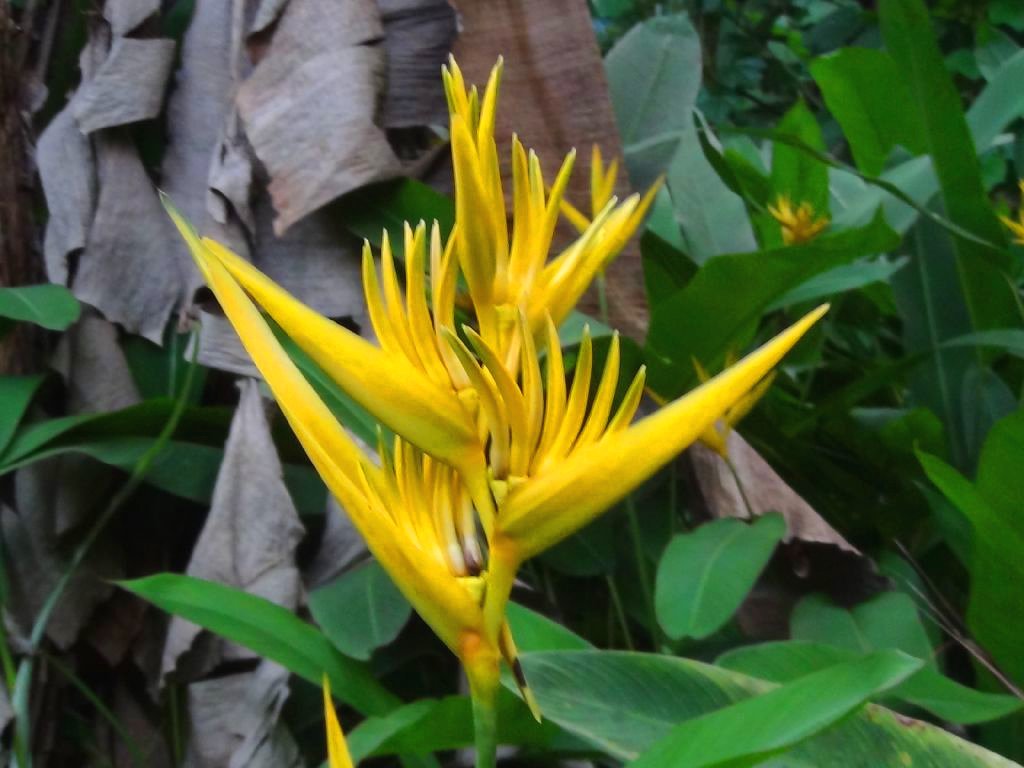
Bird of Paradise Flower

Rani imprisoned

Tiki of Iupeke

Ceremonial grounds at Ta'a'oa

Goats were common along the road

View towards Atuona - note tree ferns

Our tour group


Hibiscus flowers are worn by Polynesian women
Me'ae Iipona site at Puama'u

Prone tiki at Me'ae Iipona


Brian off  S/V Zulu looks at Tiki of Chief Takii at Me'ae Iipona 

Me'ae Iipona site at Puama'u

Marie Jo - our tour guide and Marlene off S/V Zulu

Beach at Puama'u
Ata kua - smiling tiki


Atuona


In our first couple of days, we visited Gauguin's grave, where we had a lovely picnic lunch with Mike and Karen off 'Chapter Two'. We also met Marie, a local lady, who gave us a tour of her little plantation, taught us about the local edible fruits, and showed us how to de-husk and open ripe coconuts. She loaded us down with fruit including a couple of stems of bananas that are now all ripening at once in our cabin - we hope to dry some if the sun cooperates.

We have really enjoyed the bounteous fruit - hanging from trees along every roadside. Pamplemousse, guavas, bananas, and a slightly tart fruit called a pistache that also has a seed, which can be roasted and eaten but is no relation to the pistachio we know. Rani remembers the latter fruit as a 'jamun' from her childhood in India.

Today is a chores day after our day long island tour yesterday (see next blog post) and we have taken on water and processed hundreds of photos. Rani is currently off in town visiting Marie and trying to access the Internet at the post office.

Ladybug at anchor in Taahuku Bay

View over Atuona

Climbing the hill to Gauguin's grave

Sculpture beside Gauguin's grave

Picnic with Mike & Karen

Rani and pamplemousse


Marie and her daughter Maria

The beach at Atuona

Clarion Island


A few pictures from Clarion Island, which we visited on day 6. Lovely rock formations but an untenable anchorage and no chance of landing in one piece, so we stayed only two hours.

Northwest tip of island


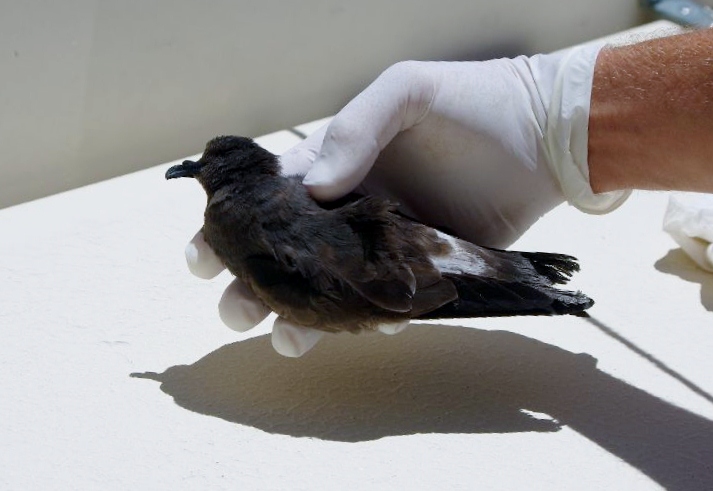
Petrel


Bahia Azufre (Sulphur Bay)

Surf on the beach - note wrecked barge behind surf break and military base to left. The swell in the anchorage was impressive!

Poor exhausted petrel passed away in our cockpit.


Pictures from the Crossing to the Marquesas


Twenty six pictures for the 26 (well 25 and a bit) days. The detailed text for these pictures can be found in previous radio posted blog entries. The photos show a mix of wildlife, weather, repair work, and celebration.

Dolphins in the bow wave

Approaching squall


Tanker passing at dusk

Blue water swim

Fixing a bulkhead bonding problem with thickened epoxy

Red footed booby on the solar panel

Flying fish rigor mortis

Baby flying fish - these fish landed on board ranging in size from an inch to 9 or 10 inches

Fixing a leak in the rudder steering tube

Fixing another leak in the traveller bolts through the coach roof.

Rani boning up on her French.

Strumming near the equator 

Getting the bubbly ready for equator celebration

Equator GPS - a bit late as we were toasting and bribing Poseidon

One for Poseidon, one for us

Sweetened rice offering to the Gods

Cleaning up after the squall (we left a hatch open!)

Squall in real life

Same squall on radar

Amazing squall area clouds

More squall clouds

Approaching Hiva Oa - We use a free chart software (OpenCPN) as back up to paper charts

Happy to see land!

Approaching Hiva Oa

The hook is down in  Taahuku  Bay, Hiva Oa

The anchorage at Taahuku


Sunday, April 15, 2012

First day in Hiva Oa

Today we walked into the little town of Atuona and bought fresh French baguettes, Brie, and Camenbert from two of the three small groceries that line the main street. Rani stopped to chat with a young Marquesan who climbed a nearby tree and picked for her a ripe pamplemousse (a sweet variety of grapefruit). Later, we climbed the hill above the town to the cemetery where the painter Gaugin is buried. Rani observed that, as in many European cities, ironically the dead enjoy the best views.

Atuona is a beautiful place - a sort of French tropical suburb as our friends Mike and Karen on 'Chapter 2', who accompanied us, put it. We ate our picnic lunch with a view from the graveyard out over an impossibly lush 1000 meter mountain, with the surf pounding on the black volcanic beach at its base. The baguettes tasted just like the ones you buy in Paris, the Brie was smooth and delicious, and the Normandy Camenbert intensely flavourful.

It was a sweltering walk back, but a friendly and very tattooed islander generously picked the four of us up and dropped us back near the boat - nice people here! The chilled beer we enjoyed in the shady cockpit of 'Chapter 2' tasted ridiculously good and Mike insisted it would restore the electrolyte balance.

Tomorrow we check in with our agent and the next day we have arranged to take a tour of the island by car to see the archeological sites and other villages.

Saturday, April 14, 2012

Land Ho - Day 25/26

Day 25 was the fastest yet. We covered 144 nautical miles, broad reaching in 15 to 20 knot easterlies during the day and lighter easterlies at night. There were squall lines still, but more spread out and with less punch than those of the previous day. Two reefs in the main, then one as the winds died. We kept the jib partially furled to reduce backing and slatting in the rolly swells. Despite this much reduced sail, we still regularly reached 8 knots on the GPS with some 9 and 10 knot surfing - great fun.

At 14:30 Zulu on Saturday April 14, our position was 09 36 S 138 29 W. We ran 144 NMs with 137 made good in the previous 24 hours.

Just before sunrise, this morning, 25 days after leaving Los Frailes, we sighted Hiva Oa lying under a bank of cloud in the pre-dawn haze. We danced on the deck hugging each other and cheering - what a sight after nearly 4 weeks at sea! We dropped the hook at 14:50 Marquesas time (UMT - 9.5 hours) and our friends Mike and Karen on 'Chapter 2' dinghied over to help us set a stern anchor (the anchorage is small and very crowded so the two anchors are needed to avoid swinging into your neighbor).

We are now anchored at 09 48 S 139 02 W in Taahuku a.k.a. 'Traitor's Bay' near the village of Atuona. There is an outrigger canoe race in progress and music is playing from the boat ramp. There is a horse grazing in the woods by a surf pounded beach off our stern and a huge cloud-shrouded green sided mountain rising to starboard. The sights and smells of this paradise are overwhelming. We will sleep well tonight.

The total distance we sailed/motored from Los Frailes, Mexico was 2932 nautical miles by our GPS 'odometer' at an average speed of 4.8 knots. We motored for 36 hours in total, using approximately 15 gallons of diesel. About 8 hours of this motoring was done mainly to recharge batteries due to problems with refrigeration. This did not contribute substantially to boat progress because we were sailing at the time. We stopped for only a couple of hours at Clarion Island and for another hour or two to scrub the boat's bottom.

This will be our last passage report for now but we will try to update the blog regularly while sailing amongst the Marquesas. Our tentative plans are to visit 5 of the islands, spending 4 or 5 days at each, before departing for the Tuomotus.

Friday, April 13, 2012

3000 Mile Diet - Day 24

Who would have thought we would still be eating Greek salad, with fresh green pepper, cucumber, tomato, red onion, black olives and Chiapas cheese, 30 days after provisioning in La Paz?

Living without a fridge for the last three years in the hot climate of Mexico has taught us a few things. We have learned to choose fresh vegetables and fruits with a discerning eye, preferring to buy non-refrigerated produce from the farmers' market. The Mexican vendors do not mind if we handle the produce to avoid bruised or over-ripe fruits/veggies. We have also discovered "new" vegetables, which naturally keep longer, like chayote (a good zucchini substitute) and jicama.

Once onboard, we carefully wrap each delicate item in brown paper, cut-up bags we had saved from bakery and wine purchases. Newspaper also works but glossy magazine paper is not good because it does not breathe. Our produce locker has stacking plastic baskets with holes in the sides for airflow and we almost always leave the lid off this locker to allow air in. These two steps seem to help prevent the goods from chafing and going moldy, keeping things dark but ventilated and not too dry.

This voyage to Polynesia is on a different scale from our usual 2 or 3 week Mexican stints. We bought enough produce to last 4-5 weeks, in case we got stuck in the doldrums, and were prepared to sacrifice some along the way. The oranges and apples were hung in hammocks, the vegetables split between the galley produce locker and an open Rubbermaid container under the quarter berth. I unwrapped and aired vegetables, other than potatoes and onions, every day or second day, depending on the sea state. We placed the most ripe tomatoes, green peppers, cauliflower and avocados in the fridge, once space became available, 7-10 days after leaving La Paz. The same applies to cut vegetables which have been partially used, like cucumber for example.

Our loss has been minimal - in more than 4 weeks of sailing - two grapefruits, one orange, one tomato and several carrots. We ate the last zucchini two days ago and still have kilos of onions and potatoes, several cukes, some carrots, cabbages, jicama, chayote, poblano peppers, and even a few tomatoes and an avocado. Admittedly, the carrots and peppers look rather gnarly. In the fruit department, we have ten oranges, lots of limes and a few dozen 5000 mile apples from Washington (via Mexico). No scurvy victims on Ladybug!

Now - we just have to get through Friday the 13th and hope that when we make landfall, the inspectors in French Polynesia allow us to keep our hard earned veggies and fruit!

More on favourite at sea recipes at a later date as I am feeling a bit nauseous in the bouncy seas today.

Our position at 1430 Zulu on Friday April 13 was 8 12 S 136 35 W. We sailed 136 NMs in the last 24 hours and are 155 NMs out of Hiva Oa. Note that the captain had us going to the wrong waypoint (40 miles east of where we should have been aiming), so our previous entries for miles to run are wrong and we will probably reach Atuona by tomorrow afternoon. He should leave the navigation to the first mate :)